Empower Healthcare Teams With Intelligent AI Assistance
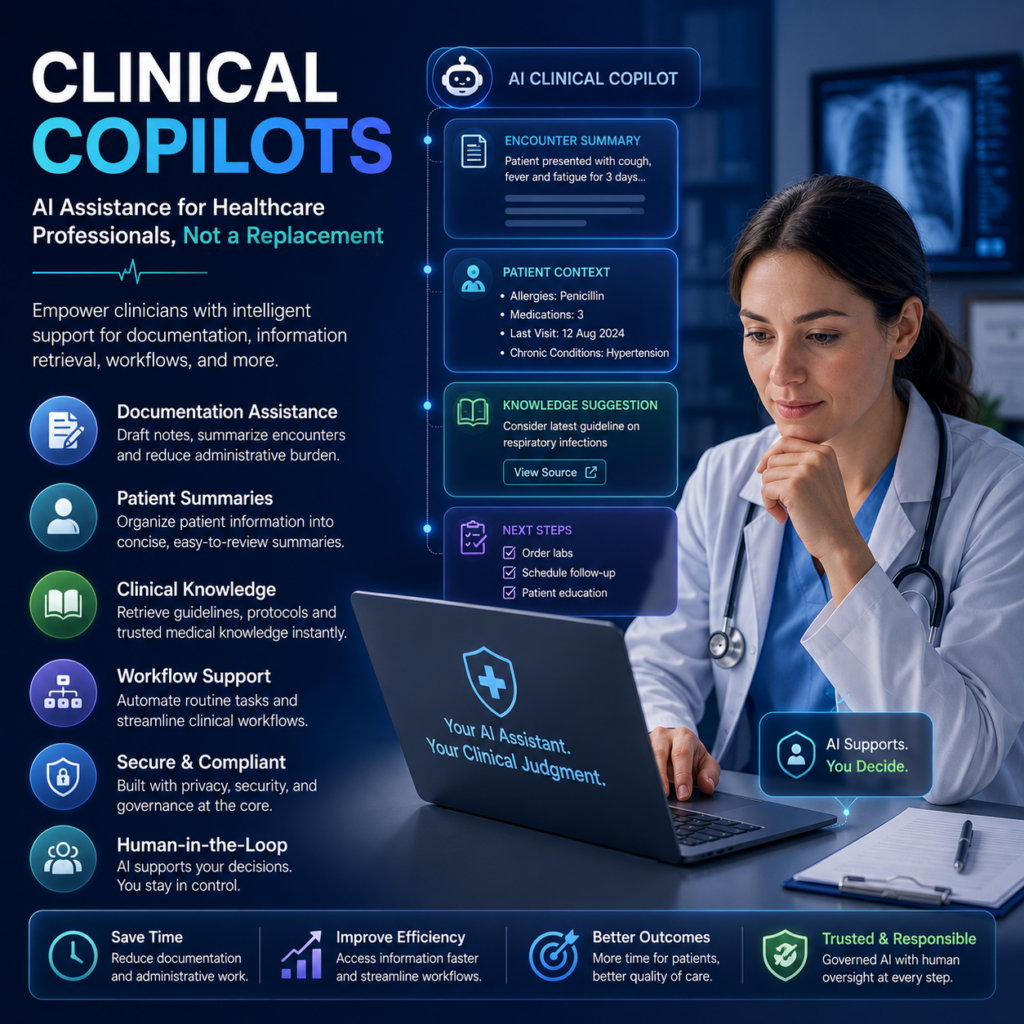
Clinical Copilots are AI-powered assistants designed to support healthcare professionals with clinical documentation, information retrieval, workflow coordination, administrative tasks, and decision-support processes while keeping qualified clinicians responsible for medical judgment and patient care. Dovix AI develops secure, enterprise-ready Clinical Copilot solutions that can connect with approved healthcare data, electronic health record systems, clinical knowledge sources, operational applications, and internal workflows. These copilots can help summarize patient information, prepare documentation, retrieve relevant knowledge, organize clinical data, support administrative workflows, and reduce repetitive tasks across healthcare environments. Because healthcare AI can directly affect patient care, Clinical Copilots should be designed with strong human oversight, privacy controls, validation, governance, and clearly defined limits. WHO guidance emphasizes that humans should remain in control of healthcare systems and medical decisions when AI is used in health.
Build Clinical AI Copilots Around Real Healthcare Workflows
Healthcare professionals work across complex systems, large volumes of information, documentation requirements, and time-sensitive workflows. Dovix AI develops Clinical Copilots that support these workflows without positioning AI as an autonomous replacement for physicians, nurses, pharmacists, or other qualified healthcare professionals. Our solutions can be designed around approved use cases, organizational policies, clinical systems, role-based permissions, and human review requirements.
Clinical Documentation Assistance
Support healthcare professionals with draft notes, structured summaries, documentation organization, and administrative record preparation.
Patient Information Summarization
Organize approved patient information into concise summaries that help clinicians review relevant history and context more efficiently.
Clinical Knowledge Retrieval
Retrieve information from approved guidelines, protocols, policies, formularies, reference documents, and internal knowledge systems.
Workflow and Task Assistance
Support routine clinical and administrative activities such as follow-ups, task preparation, documentation workflows, and information routing.
EHR and Healthcare System Integration
Connect Clinical Copilots with approved electronic health record systems, healthcare applications, databases, APIs, and internal platforms.
Human Review and Governance
Require qualified healthcare professionals to review AI-generated information before it contributes to clinical decisions or patient-facing actions.
AI-Powered Clinical Documentation Assistance
Clinical documentation can require significant time across patient encounters and healthcare workflows. Dovix AI develops Clinical Copilots that can assist with drafting, organizing, and structuring clinical documentation using information supplied through approved systems.
Depending on the implementation, a copilot may support:
- Encounter summaries
- Draft clinical notes
- Structured documentation
- Referral preparation
- Discharge documentation
- Administrative summaries
- Follow-up task preparation
- Information organization
The Clinical Copilot can help prepare information for clinician review rather than automatically finalizing medical documentation without oversight. Organizations can define templates, required fields, terminology, review workflows, and access permissions based on their operational requirements. This approach can reduce repetitive documentation work while helping clinicians retain responsibility for reviewing and approving the final clinical record.
Patient Information Summarization and Clinical Context
Healthcare professionals may need to review information distributed across histories, laboratory results, medications, notes, referrals, and other clinical records. Dovix AI can build Clinical Copilots that organize approved patient data and generate concise, structured summaries to support faster information review.
A copilot may help surface relevant information such as:
- Patient history
- Current medications
- Previous encounters
- Laboratory information
- Documented allergies
- Existing diagnoses
- Care-plan information
- Recent clinical notes
The system should not assume that generated summaries are complete or clinically correct. Clinicians should be able to review underlying source information and verify important details before making decisions. AI-generated clinical content also requires appropriate governance because errors, omissions, bias, or unsupported outputs can create healthcare risks. WHO specifically highlights privacy, bias, accountability, appropriate use, and human autonomy as important considerations for AI in health.
Clinical Knowledge and Guideline Retrieval
Clinical teams regularly work with guidelines, protocols, policies, formularies, research information, and organizational knowledge. Dovix AI can develop knowledge-grounded Clinical Copilots that retrieve relevant information from approved sources before generating responses. Retrieval-Augmented Generation, or RAG, can be used to connect the AI system with controlled healthcare knowledge repositories.
Potential knowledge sources can include:
- Clinical guidelines
- Hospital protocols
- Internal policies
- Drug formularies
- Care pathways
- Procedure documentation
- Training materials
- Approved reference libraries
Where appropriate, responses can include references or links back to the source material so clinicians can verify the information themselves. A knowledge-grounded architecture can reduce dependence on general model knowledge, but it does not eliminate the need for professional review. WHO’s guidance on large multimodal models in healthcare emphasizes governance and safeguards as these technologies increasingly enter healthcare, research, and related settings.
Integration With EHR and Healthcare Systems
Clinical Copilots become significantly more useful when they can securely interact with the applications healthcare teams already use. Dovix AI can integrate Clinical Copilot solutions with electronic health record systems, healthcare databases, scheduling tools, clinical portals, document systems, internal APIs, and approved operational applications.
Depending on system capabilities and permissions, a copilot may:
- Retrieve approved patient information
- Prepare structured summaries
- Draft documentation
- Populate workflow fields
- Retrieve policies
- Create administrative tasks
- Support referral workflows
- Route information for review
Healthcare integrations should follow strict access controls and the security, privacy, regulatory, and data-governance requirements applicable to the organization and jurisdiction. Permissions can be designed around user roles so clinicians and staff only access information appropriate to their responsibilities.
Human-in-the-Loop Clinical AI
Human oversight is a core requirement for responsible Clinical Copilot design. Clinical Copilots should support qualified healthcare professionals rather than independently making high-impact medical decisions without appropriate review. Dovix AI can design human-in-the-loop workflows where AI-generated summaries, recommendations, documentation, or retrieved information remain subject to professional verification.
Controls can include:
- Clinician approval requirements
- Confidence indicators
- Source citations
- Restricted actions
- Role-based permissions
- Audit logs
- Escalation workflows
- Output validation
- AI usage policies
- Monitoring and quality review
Higher-risk use cases may also require specific regulatory assessment depending on how the software functions and the jurisdiction in which it is deployed. WHO recommends that AI for health be developed and used with ethics, human rights, transparency, accountability, and appropriate governance at the center of deployment.
Let's Build Something Intelligent
Tell us about your AI chatbot project and our experts will get back to you.