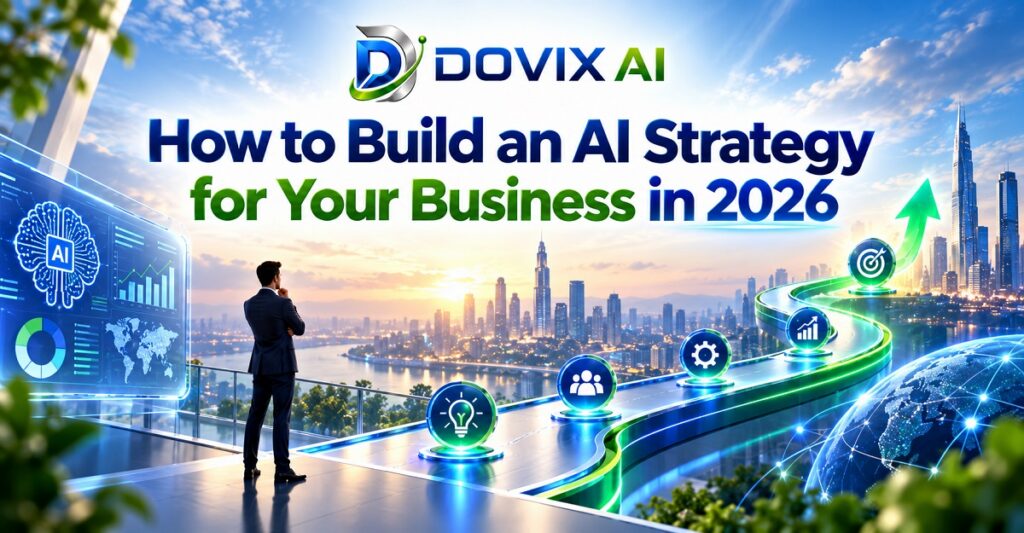
AI is no longer just a competitive advantage—it’s becoming a core part of how modern businesses operate. From automating workflows to improving customer experiences and making smarter decisions, AI is changing what businesses can achieve.
But simply adding AI tools isn’t a strategy. Real results come from knowing where AI can solve your biggest business challenges.
So, how can you build an AI strategy that delivers measurable ROI in 2026? This guide breaks down the essential steps to help you plan, implement, and scale AI with confidence.
What Is an AI Strategy for Business?
An AI strategy for business is a clear roadmap for using artificial intelligence to solve real business challenges and achieve measurable goals. It helps you decide where AI can create the most value, which technologies you need, what data is required, and how success will be measured. Instead of collecting random AI tools, a strong strategy focuses on outcomes such as saving time, reducing costs, improving customer experiences, or increasing revenue.
The key is simple: start with the business goal, then choose the AI solution. Whether you want smarter forecasting, automated workflows, better lead generation, or AI-powered customer support, your technology should always support your bigger business objectives.
Why Businesses Need an AI Strategy in 2026
AI is no longer just a technology trend—it is becoming a core business advantage. The question has shifted from “Should we use AI?” to “How can we use AI effectively to achieve better business results?” In 2026, having the right strategy can make the difference between simply experimenting with AI and creating real competitive value.
Indian businesses are increasing their AI investments rapidly, but investment alone does not guarantee success. Data quality, governance, security, legacy systems, and employee readiness can determine whether AI delivers reliable results or becomes another expensive experiment.
The next step is moving from AI experiments to AI-powered execution. A basic chatbot may answer customer questions, but a connected AI system can integrate with CRM, knowledge bases, workflows, analytics, and human teams. That is where a well-planned AI strategy turns technology into measurable business growth.
Step 1- Identify Your Business Goals
Start with the outcome, not the technology. Ask: What should AI improve? Focus on measurable goals such as reducing costs, increasing sales, improving customer service, speeding operations, reducing errors, or boosting productivity. Clear targets give your AI strategy direction and make it easier to measure success, ROI, and business impact.
Step 2 – Audit Your Workflows and Processes
Look closely at how work gets done every day. Find repetitive tasks, manual data entry, approval delays, duplicated work, information searches, and error-prone processes. These activities often reveal your biggest AI opportunities. Don’t automate everything—automate what creates the greatest value. Start with processes where AI can save time and effort.
Step 3- Assess Your Data Readiness
Great AI starts with great data. Check whether your data is accurate, complete, secure, accessible, and properly organized. Review CRM records, ERP systems, databases, documents, spreadsheets, websites, and internal knowledge bases. Identify duplicates, outdated information, disconnected systems, and security gaps before allowing AI to depend on your business data.
Step 4- Prioritize AI Use Cases
You don’t need dozens of AI projects. Start with two or three high-value opportunities that are realistic to implement. Evaluate each use case based on business impact, feasibility, cost, risk, adoption, and measurable ROI. Prioritizing intelligently helps your organization achieve faster wins while avoiding expensive projects with limited business value.
Step 5- Build, Buy, or Partner?
Not every company needs to build AI from scratch. Buy when an existing solution fits your needs. Build when your requirements are highly specialized. Partner when you need customization without creating an entire AI team internally. Compare cost, speed, complexity, security, scalability, maintenance, and long-term business requirements before deciding.
Step 6- Select the Right AI Technology
Choose technology according to the problem—not the hype. Your strategy may include Generative AI, LLMs, AI agents, chatbots, machine learning, computer vision, NLP, Voice AI, RAG, predictive analytics, or workflow automation. Select solutions that deliver the right balance of performance, reliability, security, scalability, integration, and cost for your business.
Step 7- Create an AI Governance Framework
AI needs guardrails before it reaches critical business processes. Define data policies, access controls, human oversight, testing, monitoring, accountability, and incident management. Governance becomes even more important when AI agents can trigger workflows or make decisions. A strong framework helps your organization innovate faster while managing security, privacy, compliance, and operational risks.
Step 8- Prepare Your Employees for AI Adoption
People power AI transformation. Introduce employees to AI early and explain how their roles may evolve. Provide practical training on using AI tools, checking outputs, protecting confidential information, and handling exceptions. When employees understand the benefits and boundaries, resistance decreases, adoption improves, and AI becomes a productivity partner instead of another complicated technology.
Step 9- Build a Pilot and Measure ROI
Start small, test quickly, and measure everything. Choose one clearly defined process, establish a baseline, launch your AI pilot, and track meaningful metrics. Depending on the goal, measure response time, productivity, costs, accuracy, customer satisfaction, conversions, or resolution rates. Use the results to improve the solution before investing in larger deployment.
Step 10- Scale What Works
Once your pilot proves measurable value, scale it strategically. Strengthen infrastructure, integrations, security, monitoring, and employee training as adoption grows. Don’t simply copy one solution everywhere. Build a repeatable model based on lessons learned. A successful AI strategy becomes a continuous cycle: Identify → Test → Measure → Improve → Scale → Monitor.
Why Choose Dovix AI as Your AI Strategy Partner for Your Business
Choosing the right AI partner can turn AI from an experiment into a real business advantage. Dovix AI starts by understanding your goals, challenges, workflows, and data before recommending the right AI strategy. This ensures your investment is focused on practical solutions that support measurable business outcomes.
With expertise in AI automation, AI agents, custom AI software, LLM development, chatbots, RAG, and enterprise AI solutions, Dovix AI provides a complete path from strategy and development to integration and optimization. Our approach focuses on scalable, secure, and customized solutions rather than one-size-fits-all technology.
Whether you want to automate workflows, improve productivity, enhance customer experiences, or scale operations, Dovix AI can help turn your AI vision into action. Partner with Dovix AI and build a smarter, more efficient, AI-powered business for the future.
Conclusion
Building an AI strategy for your business in 2026 is not about adopting every new AI technology that reaches the market. It is about making intelligent choices based on business priorities, operational realities, data readiness, employee needs, risk tolerance, and measurable outcomes.
The strongest strategy starts with a business problem, identifies a high-value opportunity, validates the available data, chooses the appropriate technology, establishes governance, trains the people involved, measures ROI, and then scales what works.
AI is becoming easier to access, but that does not make strategic thinking less important. If anything, the abundance of AI tools makes strategy more valuable because businesses need to know what to adopt, what to avoid, and where AI can create genuine competitive advantage.
For organizations looking to implement AI automation, AI agents, custom AI software, or enterprise AI solutions, the smartest first step is not buying a tool. It is creating a clear roadmap that connects AI investment to measurable business growth.
Frequently Asked Questions (FAQs)
[1] What is an AI strategy for a business?
An AI strategy is a structured roadmap for using artificial intelligence to achieve business goals through the right technology, data, processes, governance, and measurable outcomes.
[2] How should a small business start using AI in 2026?
Start with one or two repetitive, measurable processes, such as customer support, lead qualification, reporting, marketing automation, document processing, or workflow automation.
[3] Should businesses build AI in-house or use an AI development company?
The choice depends on your requirements, budget, expertise, and complexity. Custom AI development or a reliable partner is ideal for specialized workflows and integrations.
[4] How much does it cost to implement an AI strategy?
AI implementation costs vary by project complexity, technology, integrations, data requirements, and scalability. Start with a focused project and expand after proving measurable ROI.
[5] What is the biggest mistake when creating an AI strategy?
The biggest mistake is adopting AI without clear business objectives. Companies should identify measurable problems first, then select technologies that deliver meaningful business value.