Build Autonomous AI Agents That Think, Plan, Act & Deliver Results
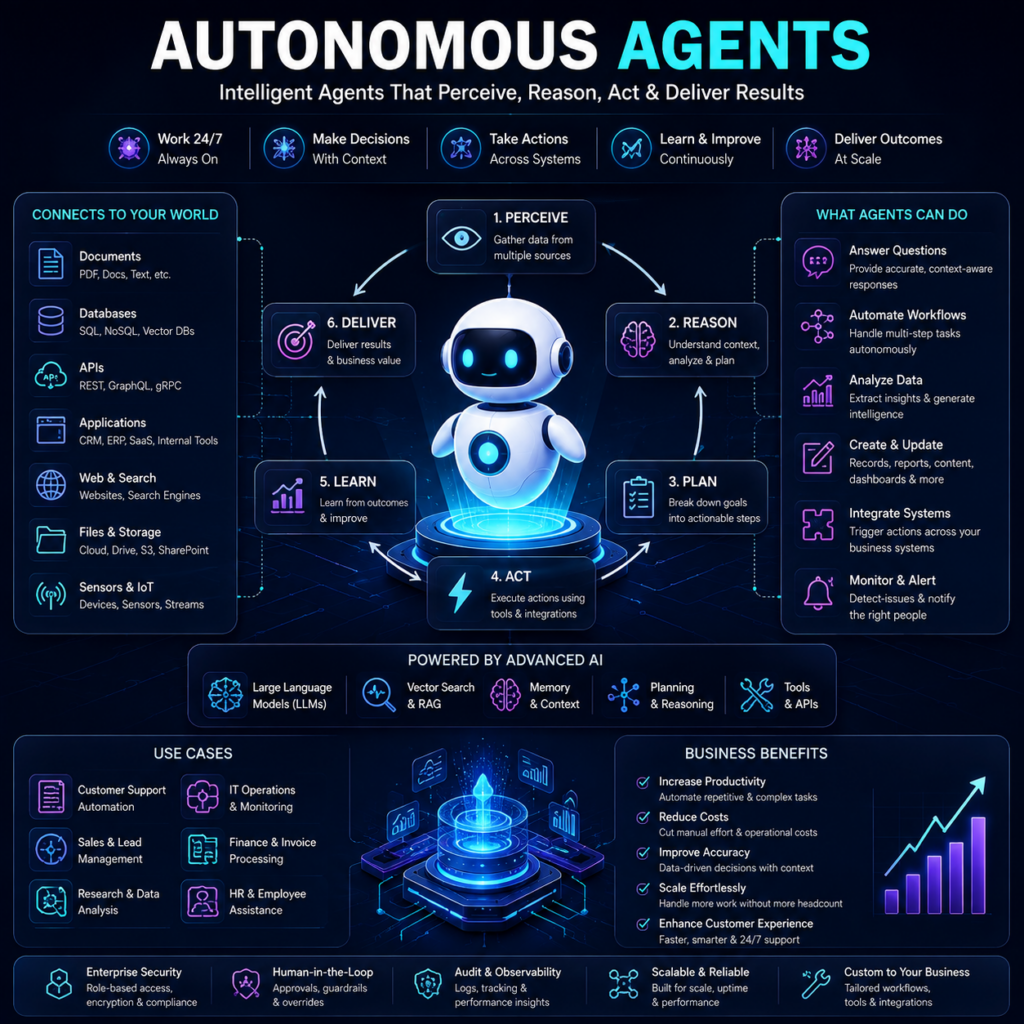
Dovix AI develops Autonomous AI Agent Solutions that help businesses automate complex workflows, make context-aware decisions, interact with enterprise systems, and complete multi-step tasks with minimal human intervention.
Unlike traditional chatbots or fixed-rule automation, autonomous agents can understand goals, retrieve information, reason through problems, plan actions, use tools, interact with APIs, monitor outcomes, and improve workflows over time.
From customer support and sales operations to finance, HR, IT, research, logistics, and enterprise automation, Dovix AI builds secure, scalable, and production-ready autonomous agents designed around real business processes.
From Basic Chatbots to Intelligent AI Conversations
Traditional chatbots rely on predefined rules and limited conversation flows. Modern AI chatbots use Large Language Models, Natural Language Processing, enterprise knowledge, APIs, and intelligent automation to deliver more natural, contextual, and useful conversations. Dovix AI develops production-ready AI chatbot solutions that understand user intent, access relevant business information, automate workflows, and integrate with your existing digital ecosystem to improve customer engagement, accelerate support, generate leads, and support business operations at scale.
Autonomous Agents & Human-in-the-Loop Control
Autonomy does not mean every action should happen without human oversight. Dovix AI can design systems where specific actions require human approval.
Agent Memory & Long-Term Context
Autonomous agents often need memory to work across longer tasks and repeated interactions. Memory can help the agent understand
Autonomous Agents & RAG
RAG gives autonomous agents access to trusted business knowledge. An agent can retrieve relevant information before planning or acting.
Sales & Lead Generation Chatbots
Engage website visitors, understand their requirements, qualify opportunities, capture customer information, and route high-value leads into your sales workflow.
Autonomous Agents & Vector Databases
Vector databases can provide semantic memory and retrieval capabilities for autonomous agents.
Autonomous Agents vs Traditional Automation
Traditional automation is built around fixed logic. Input → Rule → Action Autonomous agents are more dynamic. Goal → Context → Reasoning → Planning → Tool Use → Evaluation → Next Action
Custom Autonomous Agent Development
Every organization has different workflows, business rules, systems, data, risk requirements, and automation goals.
Dovix AI develops custom autonomous agents designed around those specific conditions.
We define:
- What goals the agent receives
- What data it can access
- Which tools it can use
- Which actions it can perform
- When human approval is required
- What rules it must follow
- How progress is monitored
- How errors are handled
- How activity is logged
The result is an agent architecture aligned with the way your business actually operates.
Goal-Based AI Agent Systems
Autonomous agents can be designed around goals rather than individual commands.
For example, instead of telling an agent:
“Check this lead and create a CRM record.”
you could provide the broader goal:
“Process and qualify all new inbound sales leads.”
The agent could then determine the workflow required:
- Read the lead
- Identify the company
- Research relevant information
- Review qualification criteria
- Score the opportunity
- Create or update the CRM record
- Draft personalized outreach
- Assign the appropriate sales representative
- Create a follow-up task
- Report the outcome
This goal-oriented approach enables more advanced automation than fixed workflow systems.
Autonomous Workflow Automation
Dovix AI builds autonomous systems that can manage multi-step business workflows across applications and data sources.
Agents can potentially automate tasks such as:
- Lead processing
- Customer onboarding
- Document review
- Ticket management
- CRM updates
- Invoice workflows
- Research
- Reporting
- Employee requests
- Operational coordination
- Data validation
- Internal approvals
- Follow-up management
Instead of requiring employees to manually move information between systems, autonomous agents can coordinate the workflow from beginning to end.
Autonomous Agents With Enterprise Tool Access
An autonomous agent becomes significantly more useful when it can interact with the systems where your business operates.
Dovix AI can connect agents with approved tools such as:
- CRM platforms
- ERP systems
- Databases
- Email systems
- Calendars
- APIs
- Customer portals
- SaaS applications
- Internal business software
- Document repositories
- Cloud storage
- Analytics platforms
- Workflow automation tools
Through these integrations, the agent can perform actual business actions instead of simply generating recommendations.
Autonomous Agents Connected to Enterprise Knowledge
Agents need reliable information if they are expected to make informed decisions.
Dovix AI can connect autonomous agents with enterprise knowledge using:
- RAG
- Vector databases
- Semantic search
- Databases
- APIs
- Knowledge bases
- Internal documentation
This allows agents to retrieve context from your business before deciding what to do.
For example, a support agent could retrieve:
- Customer account information
- Product documentation
- Previous tickets
- Warranty policy
- Troubleshooting procedures
before determining the correct next action.
Let's Build Something Intelligent
Tell us about your autonomous AI agent requirements and our experts will get back to you.