Fine-Tune Large Language Models for Your Data, Tasks & Business Goals
Dovix AI provides LLM Fine-Tuning Services that help businesses adapt Large Language Models to specific domains, tasks, workflows, terminology, and performance requirements. Instead of relying only on general-purpose models, we fine-tune AI systems using carefully prepared datasets so they can better understand your business context and generate more relevant, consistent, and task-specific outputs.
From domain adaptation and instruction tuning to conversational AI, classification, content generation, and enterprise applications, we help organizations build specialized LLM capabilities designed for real production environments.
When Should You Fine-Tune an LLM?
Fine-tuning is valuable when a business needs the model to learn patterns that are difficult or inefficient to provide repeatedly through prompts.
Consistent Output Formatting
Teach the model to return information in predefined formats or structures.
Specialized Domain Behavior
Adapt the model to industry terminology, communication patterns, and task expectations.
Classification
Train the model to reliably classify messages, documents, products, requests, or other content.
Brand Voice
Improve consistency with defined writing styles, tone, and communication guidelines.
Repetitive Complex Instructions
Reduce dependence on lengthy prompts for frequently repeated tasks.
Specialized Conversational Behavior
Improve how assistants respond to specific customer or employee scenarios.
Custom LLM Fine-Tuning for Business Applications
Dovix AI fine-tunes Large Language Models around specific business requirements, datasets, workflows, and user experiences.
Rather than creating an entirely new foundation model, we adapt suitable existing models using carefully structured training examples. The goal is to improve the model’s behavior for targeted tasks such as classification, structured output generation, domain-specific conversations, summarization, extraction, or specialized content creation.
A fine-tuned model can be integrated into websites, enterprise applications, SaaS platforms, internal tools, customer experiences, and automation workflows.
Our approach focuses on measurable improvements rather than fine-tuning simply because it is technically possible. We first evaluate whether fine-tuning, prompt engineering, RAG, or a combination of techniques is the right solution for your use case.
Domain-Specific LLM Fine-Tuning
Businesses operating in specialized industries often use terminology, processes, document structures, and communication styles that general AI models may not fully understand.
Dovix AI can fine-tune LLMs using domain-relevant datasets to improve their ability to handle specialized tasks and language patterns.
Potential domains include:
- Healthcare
- Finance
- Legal
- Real Estate
- Manufacturing
- Logistics
- E-commerce
- SaaS
- Education
- Professional Services
- Customer Support
- Technical Documentation
Domain fine-tuning can help the model produce outputs that better reflect industry terminology, formatting, workflows, and expected communication patterns.
This makes the technology more practical for specialized business applications where generic model behavior may not be sufficient.
Instruction Tuning & Task-Specific Model Optimization
Instruction tuning helps models learn how to respond more consistently to specific types of prompts and tasks.
Dovix AI can prepare instruction-response datasets that teach an LLM how to perform defined business activities according to your requirements.
Examples can include:
- Classifying customer requests
- Generating structured reports
- Extracting specific information
- Following response templates
- Producing standardized summaries
- Creating domain-specific content
- Converting unstructured text into structured data
- Categorizing documents
- Following organization-specific communication styles
Task-specific fine-tuning can be useful when businesses need predictable outputs at scale.
Instead of repeatedly explaining detailed formatting, tone, or workflow instructions inside every prompt, a fine-tuned model can learn those patterns during training.
Fine-Tuning for Conversational AI & Chatbots
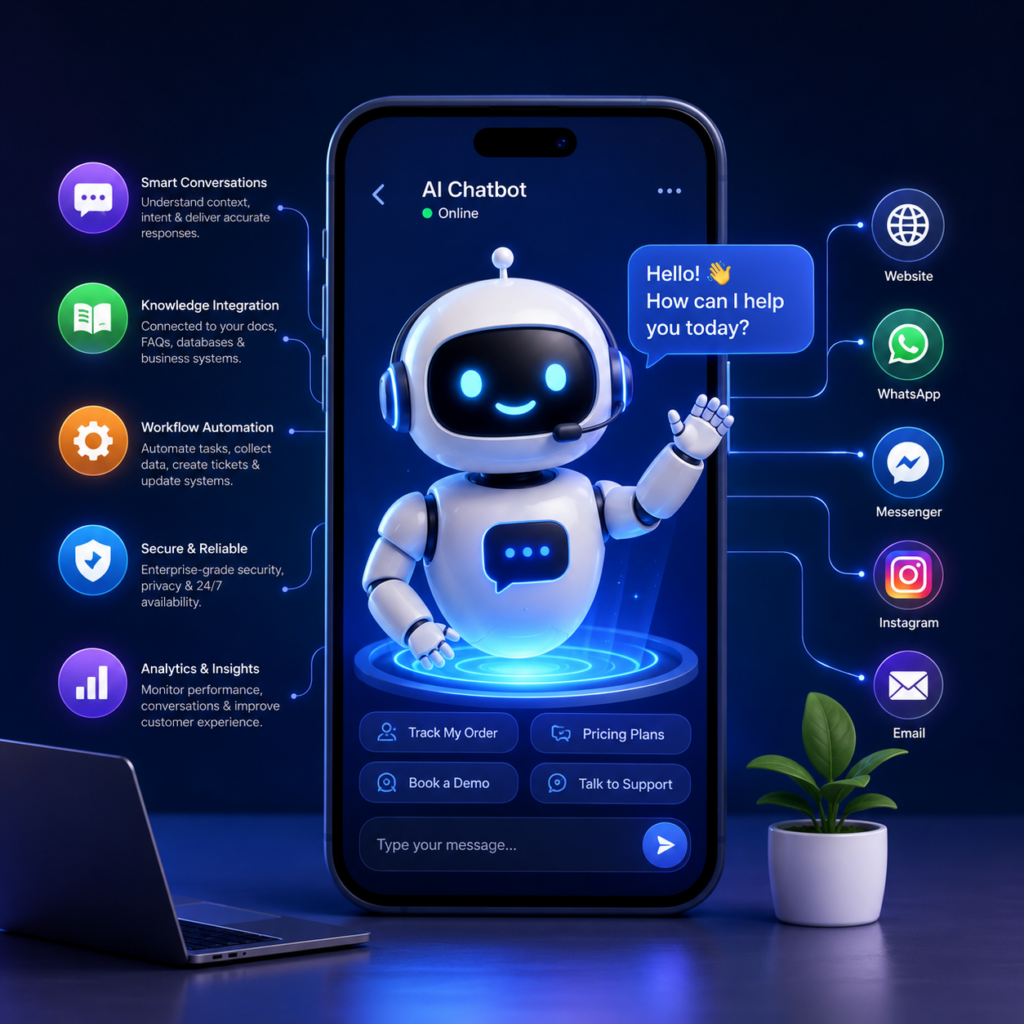
Fine-tuning can help improve chatbot behavior when a business requires a specific communication style, interaction pattern, classification capability, or specialized conversational behavior.
Dovix AI can fine-tune models using example conversations that reflect how your organization wants the chatbot to interact with customers or employees.
The training dataset can include:
- Customer questions
- Ideal responses
- Support conversations
- Sales interactions
- Escalation patterns
- Tone guidelines
- Response formats
- Intent categories
- Conversation examples
Fine-tuning can then be combined with RAG so the chatbot learns desired behavior while retrieving up-to-date information from your knowledge base.
This creates a stronger architecture than trying to encode every behavior or business rule directly into prompts.
Production-Ready Fine-Tuned LLM Deployment
Fine-tuning is only one stage of building a useful enterprise AI system. The trained model must also be evaluated, deployed, monitored, secured, and optimized for production workloads.
Dovix AI helps businesses move fine-tuned models into reliable application environments.
Depending on your requirements, this can include:
- Model serving
- API deployment
- Cloud infrastructure
- Authentication
- Access control
- Application integration
- Performance monitoring
- Evaluation pipelines
- Version management
- Model rollback
- Usage tracking
- Cost optimization
We focus on making the fine-tuned model part of a complete production architecture rather than treating the training process as an isolated experiment.
Let's Build Something Intelligent
Tell us about your LLM fine-tuning requirements and our AI experts will get back to you.