Build Accurate, Context-Aware AI Systems With Enterprise RAG
Dovix AI provides RAG Development Services that help businesses connect Large Language Models with trusted enterprise data so AI applications can deliver more relevant, contextual, and business-specific responses. Retrieval-Augmented Generation allows LLMs to retrieve the right information from documents, databases, APIs, knowledge bases, and other approved sources before generating an answer.
From enterprise knowledge assistants and AI chatbots to document intelligence, internal search, customer support, and AI agents, we design secure, scalable, and production-ready RAG systems built around your data and workflows.
Advanced RAG Pipeline Engineering
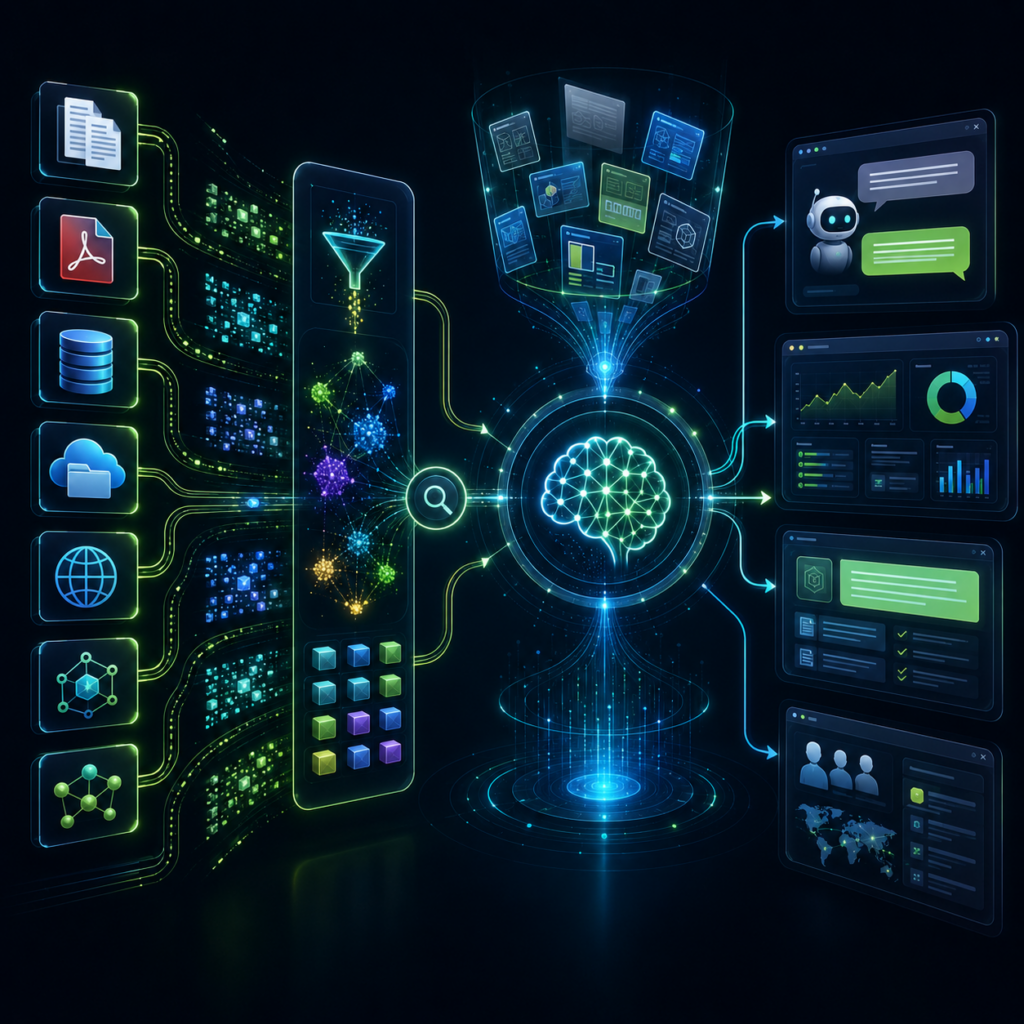
The quality of a RAG system depends heavily on how information is prepared, indexed, retrieved, and ranked. Dovix AI engineers advanced RAG pipelines designed for accuracy, relevance, scalability, and production use.
Data Ingestion
Collect information from documents, databases, APIs, websites, cloud storage, and enterprise applications.
Data Cleaning
Remove unnecessary formatting, duplicate content, noise, and irrelevant information.
Intelligent
Divide information into meaningful sections that preserve useful context.
Metadata Enrichment
Add categories, source information, timestamps, permissions, document types, and other metadata.
Vector Storage
Store embeddings inside a vector database or suitable retrieval system.
Semantic Search
Retrieve information based on meaning rather than only keyword matching.
Custom RAG Development for Business Applications
Every organization has different data sources, search requirements, workflows, users, and security needs. Dovix AI develops custom RAG solutions around your specific business environment rather than using a one-size-fits-all retrieval architecture.
Our RAG systems can be integrated into AI assistants, customer support platforms, enterprise search tools, SaaS applications, AI agents, internal portals, and automation workflows.
We design the complete retrieval pipeline, including data ingestion, preprocessing, chunking, embedding generation, vector storage, search, reranking, context construction, and LLM response generation.
By carefully engineering each stage, we help businesses create AI systems that can access relevant organizational knowledge while delivering more useful and context-aware responses.
Enterprise Knowledge Base & RAG Integration
Business knowledge is often distributed across documents, databases, applications, cloud storage, websites, and internal platforms. Finding the right information can be time-consuming for both employees and customers.
Dovix AI develops RAG systems that bring these sources together into a unified AI-powered knowledge layer.
Users can ask questions in natural language while the system retrieves relevant information from approved enterprise sources and uses that context to generate a response.
This architecture can support:
- Internal employee assistants
- Customer support copilots
- Policy and procedure search
- Technical documentation access
- Product knowledge systems
- Research assistants
- Sales enablement
- HR knowledge platforms
- Operations support
- Compliance information retrieval
The goal is to make business knowledge easier to discover and use without requiring users to search manually across multiple systems.
RAG for AI Chatbots & Conversational Assistants
AI chatbots become significantly more useful when they can work with trusted business information.
Dovix AI develops RAG-powered conversational systems that retrieve relevant knowledge before responding to customer or employee questions.
Instead of relying only on general model knowledge, the chatbot can access approved documents, FAQs, databases, policies, product information, and support documentation.
This helps create chatbots that are more aligned with your business environment.
RAG-powered chatbots can support:
- Customer support
- Product assistance
- Employee help desks
- Technical support
- Sales assistance
- Internal knowledge access
- Onboarding
- Policy questions
- Documentation search
- Customer self-service
RAG can also be combined with workflow automation so the chatbot can retrieve information and then trigger approved business actions.
Secure & Production-Ready RAG Systems
Enterprise RAG systems often work with sensitive internal information, so security and access control must be considered throughout the architecture.
Dovix AI designs production-ready RAG solutions with appropriate controls based on your business and infrastructure requirements.
Potential security capabilities include:
- Role-based access control
- User authentication
- Document-level permissions
- Secure APIs
- Data encryption
- Controlled retrieval
- Sensitive data filtering
- Audit logging
- AI guardrails
- Output validation
- Private cloud deployment
- Enterprise access policies
A secure RAG system should ensure that users only retrieve information they are authorized to access.
RAG for AI Agents
AI agents require reliable access to business knowledge if they are expected to perform complex tasks.
Dovix AI can integrate RAG with AI agent architectures so agents can retrieve relevant information before making decisions or taking actions.
For example, an AI agent could:
- Receive a customer request
- Retrieve relevant customer and product information
- Analyze the context
- Select the appropriate workflow
- Generate a response
- Update a CRM record
- Escalate the request if necessary
This combination of retrieval and action helps create more capable enterprise AI systems.
Let's Build Something Intelligent
Tell us about your RAG development requirements and our AI experts will get back to you.