
Detect Risk Earlier With AI-Powered Fraud Intelligence
Risk & Fraud Intelligence uses artificial intelligence, machine learning, behavioral analytics, anomaly detection, and advanced data analysis to help organizations identify suspicious activity, assess risk, investigate unusual patterns, and respond to potential fraud more effectively. Dovix AI develops secure and scalable Risk & Fraud Intelligence solutions that analyze transactions, user behavior, identities, devices, accounts, operational data, and relationships across connected business systems. Our solutions can identify abnormal behavior, generate dynamic risk scores, detect suspicious transaction patterns, uncover connected fraud networks, prioritize alerts, and support investigation workflows. Modern AI fraud detection commonly combines transaction history, behavioral signals, device information, identity attributes, machine learning, and graph-based analysis to identify potentially fraudulent activity.
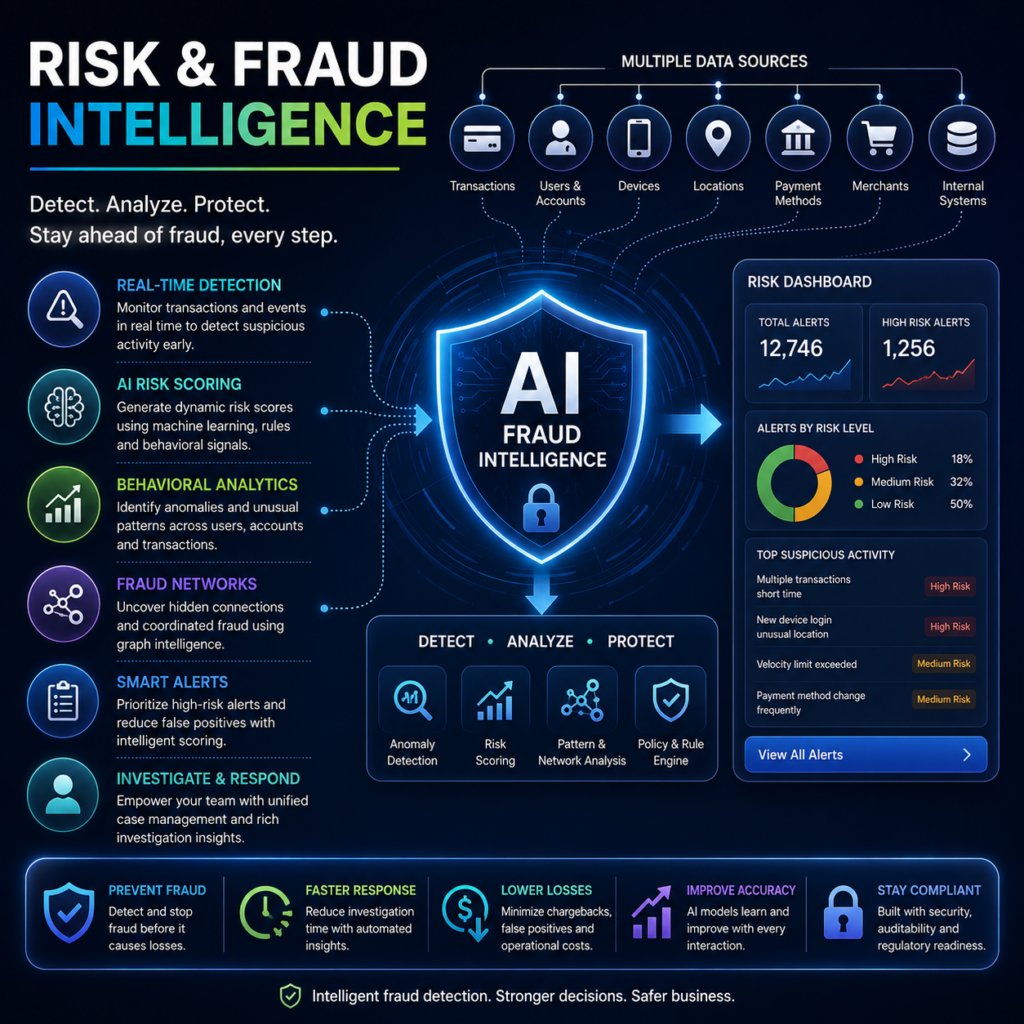
Build Intelligent Fraud Detection Around Your Business Risk
Traditional fraud controls often depend on static rules, thresholds, and isolated alerts. These methods remain useful, but sophisticated fraud can involve multiple accounts, devices, transactions, identities, and behavioral patterns that are difficult to detect through individual rules alone. Dovix AI builds Risk & Fraud Intelligence systems that combine machine learning, anomaly detection, behavioral analytics, graph intelligence, business rules, real-time data processing, and human investigation workflows. Solutions are designed around your organization’s actual risk environment, business processes, data sources, fraud scenarios, compliance requirements, and operational policies.

Real-Time Fraud Detection
Analyze transactions, events, user activity, and behavioral signals to identify potentially suspicious activity as it occurs.
AI-Powered Risk Scoring
Generate dynamic risk scores using multiple signals such as transaction patterns, behavior, identity information, devices, historical activity, and business rules.
Behavioral Anomaly Detection
Identify unusual user, account, or transaction behavior by comparing activity against historical patterns and expected behavior.
Fraud Network Intelligence
Analyze relationships between accounts, devices, identities, transactions, merchants, and other entities to uncover coordinated fraud activity.
Intelligent Alert Prioritization
Score and prioritize suspicious events so investigation teams can focus on higher-risk cases instead of manually reviewing every alert.
Investigation and Case Intelligence
Bring together relevant data, relationships, risk indicators, alerts, and supporting evidence to help analysts investigate suspicious activity more efficiently.
AI-Powered Transaction and Fraud Monitoring
Organizations processing large numbers of transactions need to identify suspicious activity quickly without treating every unusual event as fraud. Dovix AI develops fraud monitoring systems that evaluate transactions and business events using historical patterns, machine learning models, behavioral signals, and configurable risk rules.
Depending on the use case, the system can analyze factors such as:
- Transaction amount
- Frequency
- Location
- Device information
- Account history
- Login behavior
- Velocity patterns
- Merchant activity
- Customer behavior
- Identity signals
- Previous risk indicators
Transactions can receive a dynamic risk score and be approved, flagged, challenged, or routed for additional review based on configured business policies. AI and machine learning can complement rule-based controls rather than requiring organizations to replace their existing fraud infrastructure. Hybrid systems that combine deterministic rules, machine-learning scores, behavioral intelligence, and graph analytics are increasingly used in fraud detection environments.
Behavioral Analytics and Anomaly Detection
Fraud does not always match previously known patterns. Dovix AI can develop behavioral intelligence systems that establish expected patterns for customers, accounts, transactions, devices, or other entities and identify significant deviations from those patterns.
For example, unusual activity may include:
- Unexpected transaction frequency
- Sudden changes in transaction value
- Abnormal login activity
- New or unusual devices
- Unexpected locations
- Rapid account changes
- Unusual purchasing patterns
- Changes in normal payment behavior
Machine learning models can analyze historical activity to establish behavioral baselines and identify anomalies that deserve further investigation. Unsupervised learning can also help identify suspicious patterns when labeled fraud examples are limited or when organizations want to detect previously unseen behavior. Anomaly detection does not automatically prove fraud. Suspicious events should be evaluated within the wider customer, transaction, and business context.
Graph Analytics and Fraud Network Detection
Fraudulent activity often involves relationships rather than isolated transactions. Multiple accounts may share the same device. Several identities may use related addresses, payment methods, IP addresses, merchants, or transaction paths. Fraud rings may also distribute activity across many accounts to avoid simple rule-based detection. Dovix AI can build graph-based fraud intelligence systems that map relationships between entities such as:
- Customers
- Accounts
- Transactions
- Devices
- IP addresses
- Payment methods
- Merchants
- Locations
- Email addresses
- Phone numbers
Graph analytics can help identify suspicious clusters, shared infrastructure, unusual transaction networks, and potentially coordinated behavior. Graph-based approaches are particularly useful because they allow investigators to evaluate relationships across connected entities instead of reviewing each transaction independently. The resulting intelligence can be combined with machine-learning risk scores and business rules to strengthen fraud investigation workflows.
Intelligent Risk Scoring and Alert Prioritization
Fraud operations can generate large volumes of alerts, making prioritization critical. Dovix AI develops intelligent risk-scoring systems that combine multiple risk signals into a structured score or priority level.
Risk scoring may consider:
- Historical behavior
- Transaction characteristics
- Identity information
- Device signals
- Geographic activity
- Account relationships
- Previous alerts
- Behavioral anomalies
- Graph-based risk indicators
- Business rules
Instead of treating every alert equally, investigation teams can use risk scores to prioritize the cases that require the most immediate attention. Models can also be combined with predefined rules so organizations maintain control over critical business and compliance decisions. Risk scores should support analysts rather than automatically determine that an individual or transaction is fraudulent without appropriate evidence and review.
Fraud Investigation and Human-in-the-Loop Intelligence
AI fraud detection is most effective when suspicious activity can move efficiently from detection to investigation. Dovix AI builds human-in-the-loop fraud intelligence workflows that organize alerts, transaction information, behavioral indicators, relationships, and supporting evidence for analysts.
An investigation workspace can provide:
- Risk scores
- Alert history
- Transaction timelines
- Account relationships
- Device connections
- Behavioral anomalies
- Relevant customer information
- Model explanations
- Supporting documents
- Investigation notes
AI can also help summarize complex cases and highlight potentially relevant patterns, while trained investigators remain responsible for reviewing evidence and making high-impact decisions. This is particularly important because unusual behavior can have legitimate explanations and automated detection systems can generate false positives. Transaction-monitoring systems therefore require additional investigation before suspicious activity is conclusively classified.
Let's Build Something Intelligent
Tell us about your AI chatbot project and our experts will get back to you.