Build Fast, Scalable & Intelligent AI Search Infrastructure
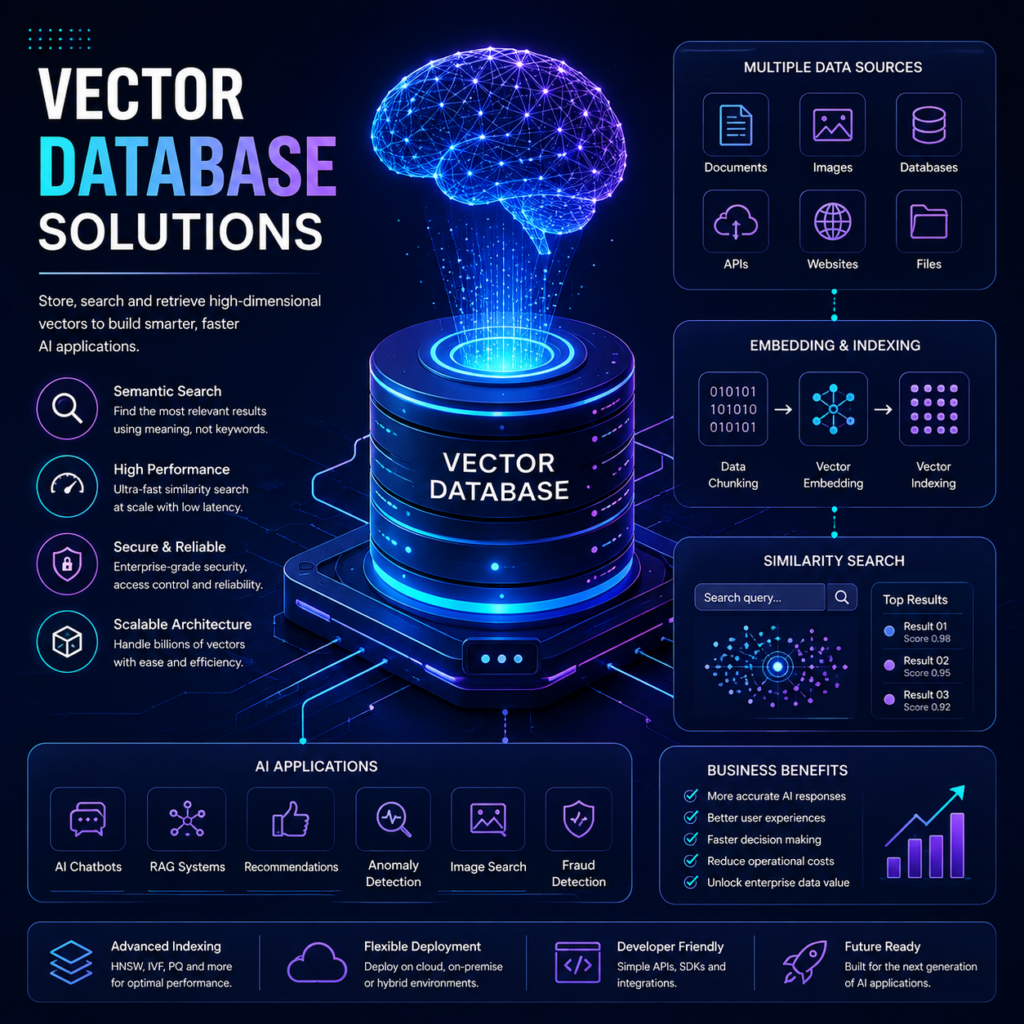
Dovix AI provides Vector Database Solutions for businesses building modern AI applications, Retrieval-Augmented Generation systems, semantic search platforms, recommendation engines, AI assistants, and intelligent automation.
We design and implement production-ready vector search infrastructure that helps AI applications retrieve the most relevant information from large volumes of enterprise data using semantic similarity rather than relying only on traditional keyword matching.
From vector database selection and embedding architecture to indexing, hybrid retrieval, metadata filtering, performance optimization, security, and enterprise integration, Dovix AI helps organizations build reliable AI retrieval infrastructure designed for real-world workloads.
Vector Database Technologies We Can Work With
Traditional chatbots rely on predefined rules and limited conversation flows. Modern AI chatbots use Large Language Models, Natural Language Processing, enterprise knowledge, APIs, and intelligent automation to deliver more natural, contextual, and useful conversations. Dovix AI develops production-ready AI chatbot solutions that understand user intent, access relevant business information, automate workflows, and integrate with your existing digital ecosystem to improve customer engagement, accelerate support, generate leads, and support business operations at scale.
Pinecone
Managed vector database infrastructure designed for scalable semantic search and RAG applications.
Weaviate
Vector database supporting semantic retrieval, hybrid search, metadata filtering, and AI applications.
Qdrant
High-performance vector search engine suitable for production AI workloads.
Milvus
Open-source vector database designed for large-scale embedding search.
FAISS
High-performance similarity search library commonly used for local or custom vector retrieval architectures.
pgvector
Vector search extension for PostgreSQL that enables embeddings to be stored alongside traditional relational data.
Why Vector Databases Matter for Modern AI
Large Language Models are powerful, but they cannot automatically access every piece of information stored inside your organization.
Businesses often have important knowledge spread across:
- Documents
- PDFs
- Databases
- CRM systems
- ERP platforms
- Product catalogs
- Knowledge bases
- Websites
- Support documentation
- Cloud storage
- Internal applications
- APIs
Vector databases create a searchable intelligence layer across these information sources.
By converting business information into embeddings, AI applications can retrieve relevant context quickly and use that information for search, RAG, recommendations, classification, personalization, and decision support.
A well-designed vector database architecture helps businesses build AI systems that are more relevant, scalable, and connected with real enterprise knowledge.
Custom Vector Database Architecture
Every AI application has different requirements for scale, speed, security, retrieval quality, metadata, and data volume.
Dovix AI designs custom vector database architectures based on your actual business use case instead of using a generic implementation.
We evaluate:
- Data volume
- Expected vector count
- Query frequency
- Latency requirements
- Embedding dimensions
- Data update frequency
- Metadata requirements
- Access permissions
- Cloud environment
- Existing databases
- Application architecture
- Expected user growth
Based on these requirements, we design a vector storage and retrieval architecture that supports fast semantic search and scalable AI workloads.
Our vector database solutions can support applications such as:
- RAG systems
- AI chatbots
- Enterprise search
- Recommendation engines
- AI agents
- Document intelligence
- Product discovery
- Customer support
- SaaS AI features
- Knowledge assistants
Vector Database Integration for RAG Systems
Vector databases are one of the most important components in many Retrieval-Augmented Generation (RAG) architectures.
A typical RAG workflow includes:
Enterprise Data → Data Processing → Chunking → Embeddings → Vector Database → Retrieval → LLM → Response
When a user asks a question, the application converts the query into an embedding and compares it with vectors stored inside the database.
The system then retrieves the most relevant information and sends it to the Large Language Model as context.
Dovix AI designs complete vector retrieval layers that can include:
- Data ingestion
- Document parsing
- Intelligent chunking
- Embedding generation
- Vector indexing
- Similarity search
- Metadata filtering
- Hybrid retrieval
- Reranking
- Context construction
- LLM integration
This helps businesses build RAG systems that can access large knowledge bases efficiently.
Semantic Search Development
Traditional keyword search looks primarily for exact words or phrases.
Semantic search attempts to understand the meaning behind the user’s query.
Dovix AI develops vector-powered semantic search solutions that allow businesses to search large information collections using natural language.
For example, a user might search:
“What are our procedures for returning damaged products?”
The system could retrieve internal documentation titled:
“Defective Product Replacement Policy”
even if the exact words from the query are not present.
Semantic search can be valuable for:
- Enterprise knowledge search
- Product search
- Documentation platforms
- Customer support
- Internal employee search
- Research applications
- Developer documentation
- Legal document search
- Healthcare information retrieval
- Technical knowledge systems
Hybrid Search & Intelligent Retrieval
Semantic search is powerful, but some enterprise use cases still require exact keyword matching.
Technical codes, product SKUs, policy numbers, legal references, names, and specific terminology may be better retrieved using keyword-based methods.
Dovix AI can develop hybrid search systems that combine:
- Vector similarity search
- Keyword search
- Metadata filters
- Full-text search
- Query rewriting
- Reranking
This combination can improve retrieval quality by balancing contextual meaning with exact information.
Hybrid search is especially useful for enterprise environments where both natural-language understanding and precise terminology matter.
Let's Build Something Intelligent
Tell us about your vector database, semantic search, RAG or AI retrieval requirements and our experts will get back to you.